
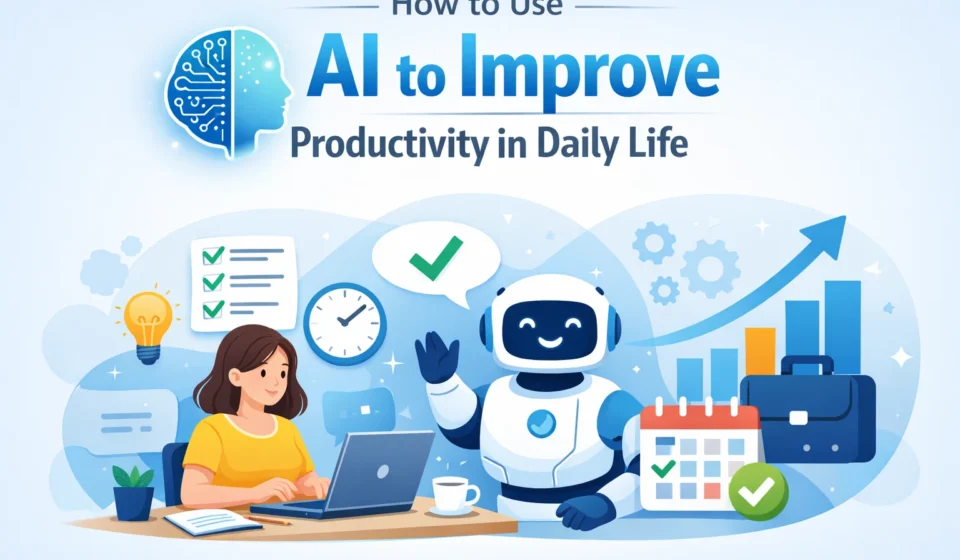

Productivity today is not about working longer hours. It’s about working smarter. With constant notifications, multitasking, and digital overload, many people feel busy but not truly productive. This is where Artificial Intelligence (AI) can quietly transform daily life.
AI is no longer limited to tech experts or large companies. It is now built into everyday tools that help you write faster, organize tasks, manage schedules, automate routine work, and even make better decisions. When used properly, AI becomes a personal assistant that reduces mental load and saves time.
This guide will explain how AI improves productivity, how it works in simple terms, and practical ways you can use it every day.
How AI Boosts Productivity
AI systems are designed to analyze patterns, process information quickly, and generate helpful outputs. Instead of manually organizing data, writing drafts, or planning schedules, AI tools can complete these tasks in seconds.
Behind the scenes, AI models study large amounts of information and learn patterns. When you give instructions, they predict the most relevant output based on what they’ve learned. The result is faster task execution and reduced repetitive work.
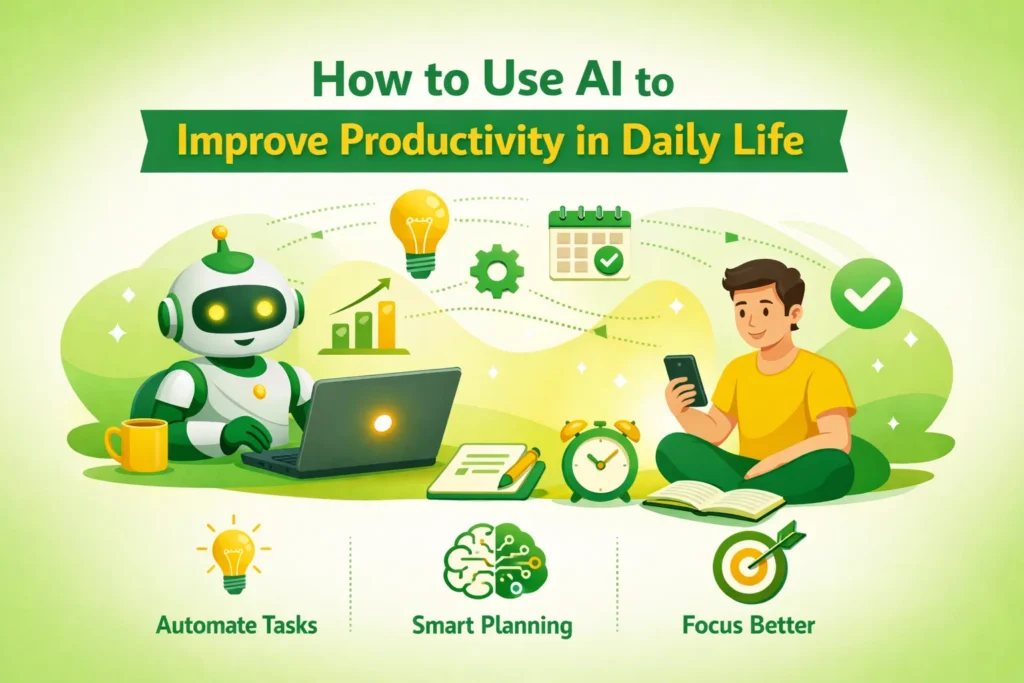
However, AI does not replace your thinking. It supports it. You still decide the direction, goals, and final decisions. AI simply accelerates the process.
Practical Ways to Use AI in Daily Life
Let’s break this into real, practical uses.
1. AI for Task Planning and Time Management
Many people struggle with planning their day. AI tools can:
- Create structured to-do lists
- Prioritize tasks based on urgency
- Suggest daily schedules
- Break large projects into smaller steps
For example, instead of staring at a long list of tasks, you can ask AI to organize them into a realistic plan for the day. This reduces decision fatigue and mental stress.
Over time, this habit improves clarity and focus because you spend less energy planning and more energy executing.
2. AI for Writing and Communication
Emails, reports, messages, and content creation consume a large part of daily time.
AI can help by:
- Drafting professional emails
- Improving grammar and clarity
- Summarizing long documents
- Generating ideas quickly
Instead of spending 30 minutes writing an email from scratch, you can create a draft in minutes and refine it. This doesn’t remove your voice — it speeds up the process.
The key is to edit and personalize the output so it sounds natural and human.
3. AI for Learning Faster
Learning new skills often feels overwhelming. AI can simplify this process.
You can use AI to:
- Explain complex topics in simple language
- Create study plans
- Summarize books or articles
- Generate practice questions
This turns AI into a personalized tutor available anytime. Instead of searching through multiple websites, you receive structured explanations instantly.
Faster learning means better skill development and improved long-term productivity.
4. AI for Automating Repetitive Tasks
Repetitive tasks drain mental energy. Automation tools powered by AI can handle:
- Sorting emails
- Scheduling appointments
- Data entry
- Social media posting
- Basic customer responses
When these small tasks are automated, your brain remains focused on meaningful work.
The future of productivity lies in automation. People who automate routine processes free up time for creativity and strategy.
5. AI for Decision Support
Sometimes productivity drops because decision-making becomes exhausting.
AI can assist by:
- Analyzing data quickly
- Comparing options
- Generating pros and cons
- Providing structured recommendations
For example, if you’re choosing between business ideas, AI can help outline advantages and risks for each option. While the final decision remains yours, AI reduces confusion.
Clearer decisions lead to faster action.
6. AI for Personal Organization
AI tools can help organize:
- Notes
- Documents
- Meeting summaries
- Project information
Some systems can even summarize meetings automatically and highlight action points. This prevents information overload and keeps everything structured.
When your information is organized, your mind feels organized too.
The Future Impact of AI on Personal Productivity
AI-driven productivity is still in its early stages. In the coming years, we will see:
- Smarter personal assistants that understand context
- AI systems that predict tasks before you ask
- Fully automated workflows for professionals
- Personalized productivity systems based on behavior patterns
Work will shift from manual effort to intelligent oversight. Instead of doing everything yourself, you will manage systems that do it for you.
However, the most productive individuals will not be those who rely blindly on AI. They will be those who understand how to guide and refine it.
AI is a multiplier. It amplifies your habits — good or bad
Important Tips for Using AI Effectively
To truly improve productivity, use AI wisely.
1. Be Clear With Instructions
The quality of output depends on the clarity of your input.
Specific instructions produce better results.
Instead of saying:
“Help me plan my day.”
Say:
“Create a 6-hour focused work plan with 30-minute breaks for deep work tasks.”
Clarity increases usefulness.
2. Always Review and Refine
AI saves time, but it is not perfect.
Always:
- Check accuracy
- Improve tone
- Add personal judgment
Human thinking is still essential.
3. Avoid Overdependence
AI should reduce workload, not reduce thinking ability.
Use it to:
- Support creativity
- Organize ideas
- Speed up execution
But continue developing your own skills.
4. Focus on High-Impact Tasks
Use AI for low-value, repetitive tasks.
Spend your time on:
- Strategy
- Relationships
- Creativity
- Long-term planning
That’s where real growth happens.
Common Mistakes to Avoid
Many people misuse AI and see little benefit.
Avoid:
- Copying outputs without editing
- Using AI without a clear goal
- Automating everything blindly
- Ignoring privacy and data security
AI works best when guided with intention.
Why AI Productivity Matters Today
Time has become the most valuable resource. The digital world moves fast, and expectations are higher than ever.
Those who use AI effectively can:
- Complete tasks faster
- Learn skills quicker
- Reduce stress
- Increase output without burnout
The productivity gap between AI users and non-users is growing.
In the near future, AI literacy will become as important as basic digital literacy.
Conclusion
Using AI to improve productivity in daily life is not about replacing effort. It is about optimizing it.
AI can:
- Plan your tasks
- Draft your communication
- Summarize information
- Automate routine work
- Support better decisions
But the real power lies in how you use it.
Think of AI as a highly efficient assistant. It works best when you provide direction, purpose, and critical thinking.
Productivity in the AI era is not about doing more work.
It’s about doing the right work — faster, smarter, and with less stress.
Start small. Automate one task. Improve one workflow.
Then gradually build your own AI-powered productivity system.
The future belongs to those who work intelligently — not just tirelessly.
Do I need technical skills to use AI for productivity?
No, most AI tools are designed for everyday users and do not require coding knowledge. Basic digital skills and the ability to write clear instructions are enough to use AI for writing, planning, organizing tasks, and research.
What are the best ways to start using AI in daily life?
You can start by using AI for simple tasks like drafting emails, summarizing articles, creating to-do lists, planning meals, generating content ideas, or managing schedules. Begin small and gradually integrate AI into your workflow.
Is it safe to use AI tools for personal or work tasks?
AI tools are generally safe when used responsibly. Avoid sharing sensitive personal data, confidential company information, or passwords. Always review privacy policies and use trusted platforms with strong security practices.
Will relying on AI make me less productive in the long run?
AI can improve productivity when used as a support tool, not a replacement for thinking. Over-reliance without understanding tasks may reduce skill development, but balanced use can enhance efficiency and learning.
Can AI help reduce stress and burnout?
Yes, AI can automate repetitive tasks, organize schedules, and simplify complex work. By reducing workload and saving time, AI can help lower stress levels and improve work-life balance when used effectively.