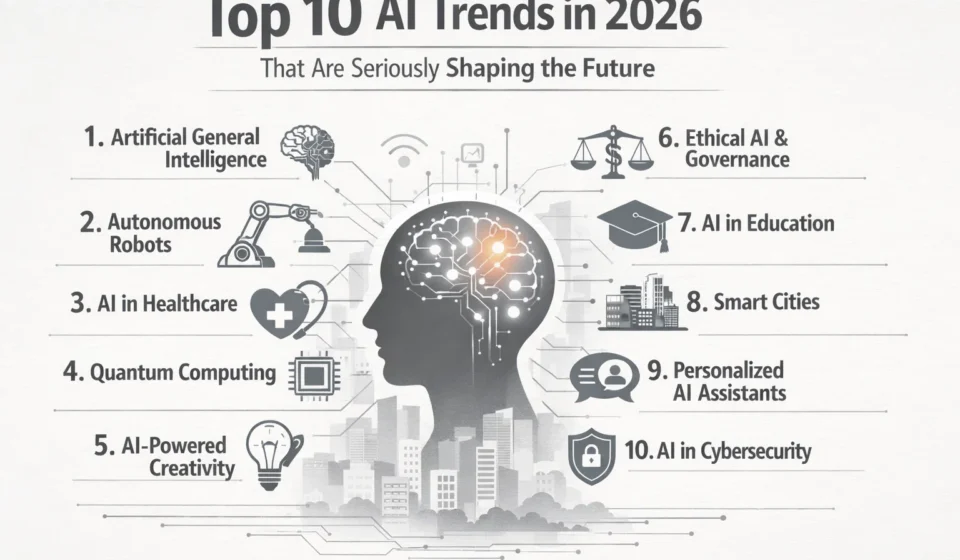

What Is Happening With AI in 2026?
Artificial Intelligence in 2026 is not just a tool people experiment with — it has become part of daily infrastructure. It supports hospitals, powers businesses, filters online content, protects cybersecurity systems, and even guides education. The major shift is that AI is no longer only executing tasks; it is assisting in decision-making.
Unlike traditional software, AI systems learn from data. They analyze patterns across massive datasets and generate predictions based on probability. That’s why AI can recommend what you should watch next, detect fraud in banking systems, or suggest strategies in business meetings.
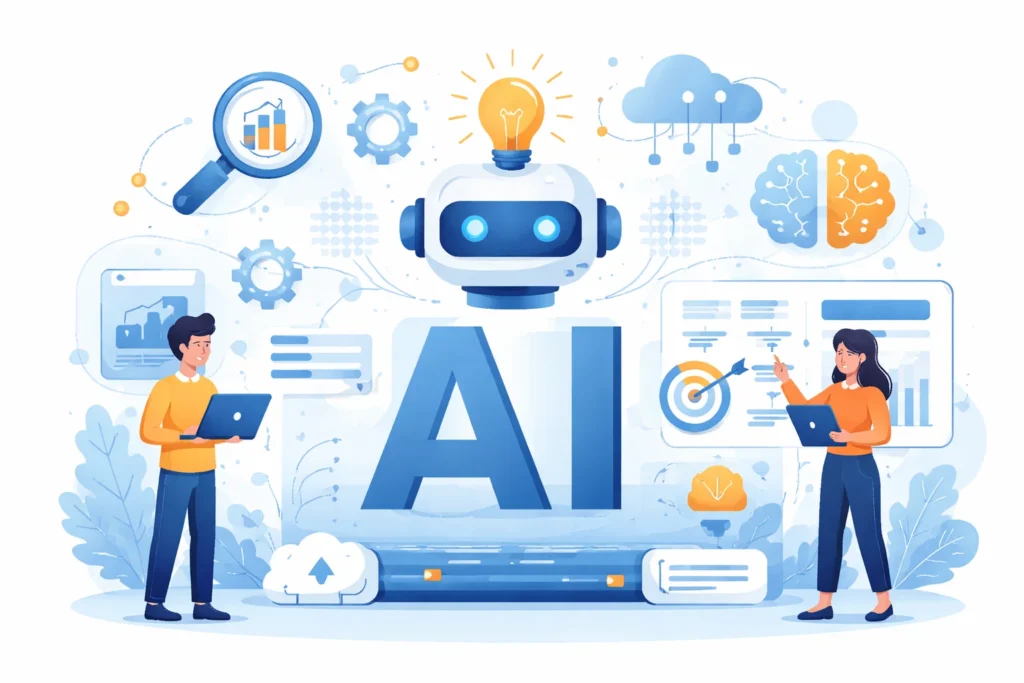
The speed of AI improvement is what makes 2026 critical. Capabilities that seemed impossible five years ago are now mainstream. Let’s now break down the most important AI trends — clearly and properly.
1. AI as a Workplace Intelligence Partner
AI has become a digital co-worker inside modern offices. It is no longer limited to chatbots — it now drafts emails, summarizes long meetings, analyzes financial spreadsheets, forecasts trends, and even helps create marketing strategies. Many companies have integrated AI directly into their internal systems, making it part of daily workflows.
How It Works
These systems are built on large language models and predictive algorithms. They process company data, communication history, sales records, and performance metrics. By recognizing patterns in this data, AI generates summaries, identifies risks, and suggests next steps almost instantly.
Why It Matters
Time is one of the most valuable business resources. AI reduces repetitive administrative work, allowing employees to focus on higher-level thinking like strategy, leadership, and creativity. Productivity levels increase significantly when AI handles routine analysis.
Future Impact
Jobs are not disappearing completely, but job descriptions are changing. The most valuable professionals will be those who know how to guide, supervise, and collaborate with AI systems rather than compete with them. Many organizations are already evaluating employees based on how effectively they use AI tools.
2. AI in Healthcare and Predictive Medicine
AI is transforming healthcare from a system that reacts to illness into one that predicts it. Hospitals now use AI to analyze medical scans, detect early signs of disease, and assist doctors in treatment decisions. Instead of waiting for severe symptoms, AI helps identify risks much earlier.
How It Works
Healthcare AI systems are trained on millions of medical images, lab reports, and patient histories. Using machine learning, they identify patterns linked to specific diseases. For example, AI can detect subtle abnormalities in imaging scans that might be difficult for the human eye to notice.
Why It Matters
Early detection saves lives and reduces healthcare costs. AI supports doctors by providing faster and sometimes more precise analysis, especially in data-heavy areas like radiology.
Future Impact
Medicine may shift toward preventive care rather than reactive treatment. However, ethical questions about patient data privacy and decision-making authority will grow as AI systems become more accurate and trusted.
3. Generative AI and the Content Revolution
Generative AI is changing how content is created. In 2026, AI can write articles, generate realistic images, compose music, produce video scripts, and even create software code. Businesses, creators, and marketers now rely on AI tools to produce high-quality content at remarkable speed.
How It Works
Generative AI models are trained on enormous datasets of text, images, and media. They learn patterns in structure and style. When given a prompt, they predict the most likely sequence of words, visuals, or sounds that match the request.
Why It Matters
Content creation has become faster, cheaper, and more accessible. Small businesses can compete with larger corporations because AI reduces production barriers.
Future Impact
Creativity will evolve into a collaboration between humans and machines. Instead of replacing creative professionals, AI will become a powerful assistant. However, debates about originality, ownership, and authenticity will intensify.
4. Hyper-Personalization Through AI
AI is deeply personalizing digital experiences. From shopping recommendations to streaming suggestions, platforms now tailor content specifically to each user’s behavior.
How It Works
AI collects and analyzes user behavior such as search history, clicks, purchases, and time spent on content. It builds predictive models that estimate what a person is most likely to engage with next.
Why It Matters
Personalization improves convenience. It saves time and increases user satisfaction because people see more relevant content.
Future Impact
As personalization becomes more accurate, privacy concerns will increase. The challenge will be balancing convenience with data protection. AI will know users better than ever — and society will need clear boundaries.
5. AI-Powered Automation in Physical Industries
AI is no longer limited to digital tasks. In warehouses, factories, and logistics centers, AI-powered robots are performing physical work with precision and speed.
How It Works
These systems combine robotics, computer vision, and real-time data processing. Sensors help machines understand their surroundings, while AI algorithms guide their movements and decision-making.
Why It Matters
Automation reduces operational costs and improves efficiency. Businesses can operate faster with fewer errors.
Future Impact
Manual repetitive jobs may decline, but new roles in robotics maintenance, AI engineering, and system supervision will grow. Workforce reskilling will become essential.
6. AI in Cybersecurity
Cybersecurity has become an AI-driven battlefield. As hackers use AI to create smarter attacks, companies are using AI to defend against them.
How It Works
AI monitors network activity continuously, identifying unusual patterns that may indicate threats. It can respond automatically to suspicious behavior before human analysts intervene.
Why It Matters
Digital infrastructure is now critical to economies. AI provides faster detection and response to cyber threats than traditional security systems.
Future Impact
Cybersecurity will increasingly rely on AI-versus-AI systems. The strength of defensive algorithms will determine digital safety in the coming years.
7. AI Regulation and Ethical Governance
As AI grows more powerful, governments are introducing regulations to ensure transparency and fairness. Concerns about bias, misinformation, and deepfakes are shaping policy discussions.
How It Works
AI systems learn from historical data. If that data contains bias, the AI may reproduce it. Regulatory frameworks aim to audit, monitor, and ensure responsible AI deployment.
Why It Matters
Without oversight, AI systems could create social inequality or misinformation at scale.
Future Impact
The balance between innovation and regulation will shape global competitiveness. Nations that regulate wisely may lead in AI development.
8. AI in Education
AI-powered tutoring systems are personalizing education. Students now use adaptive learning platforms that adjust to their pace and understanding.
How It Works
These systems analyze student performance and identify weaknesses. They modify lessons in real time to improve comprehension.
Why It Matters
Education becomes more accessible and tailored to individual needs.
Future Impact
Traditional classrooms may evolve into AI-assisted learning environments. However, ethical concerns about overdependence and academic integrity will continue.
9. Voice AI and Human-Like Interaction
Voice assistants have become more natural and context-aware. They can understand tone, remember previous conversations, and respond more fluidly.
How It Works
Advanced speech recognition models process voice input and convert it into structured data. Natural language processing systems interpret meaning and generate responses.
Why It Matters
Human-computer interaction feels more intuitive and seamless.
Future Impact
Voice AI may become emotionally aware, detecting mood from speech patterns. This opens new possibilities but also raises privacy concerns.
10. Human-AI Collaboration
The most powerful trend is collaboration. AI is not replacing human intelligence — it is amplifying it.
How It Works
AI handles data-heavy processing, while humans provide judgment, creativity, and ethical reasoning.
Why It Matters
This partnership increases innovation and productivity beyond what either could achieve alone.
Future Impact
The future will belong to those who understand how to work alongside AI. Adaptability, critical thinking, and ethical awareness will become essential skills.
Conclusion
Artificial Intelligence in 2026 is no longer just an emerging technology — it has become a core part of how businesses operate, how healthcare improves outcomes, and how people interact with the digital world. From workplace automation to personalized experiences, AI is quietly shaping decisions that affect everyday life.
The future isn’t about AI replacing humans; it’s about humans learning to work alongside it. Those who adapt, upskill, and understand how to use AI responsibly will benefit the most. At the same time, ethical use and smart regulation will be essential to ensure AI remains a tool for progress.
AI is not coming in the future — it is already here. The real question is how well we prepare ourselves to grow with it.
Will AI replace jobs in 2026?
AI is expected to automate repetitive and routine tasks in 2026, but it is unlikely to replace entire professions. Instead, it will reshape roles by increasing efficiency and creating demand for new skills such as AI management, prompt writing, and data analysis.
Which industries are being most affected by AI right now?
Industries such as customer service, marketing, finance, healthcare, manufacturing, and logistics are currently seeing major AI adoption. Automation tools, chatbots, predictive analytics, and AI-driven content creation are transforming how these sectors operate.
How is AI helping small businesses?
AI helps small businesses by reducing costs, automating customer support, improving marketing strategies, analyzing sales data, and generating content. Affordable AI tools allow small companies to compete more effectively with larger corporations.
Is AI regulated globally?
AI regulation varies by country. Some regions are developing strict guidelines for data privacy, ethical AI use, and transparency, while others are still building regulatory frameworks. Global discussions continue about responsible AI development and oversight.
What skills are important in an AI-driven future?
Critical thinking, digital literacy, adaptability, data interpretation, prompt engineering, and problem-solving are key skills. Human creativity and emotional intelligence will also remain highly valuable alongside AI systems.
Are AI tools safe to use for personal or business data?
AI tools can be safe if used responsibly. Always check privacy policies, avoid sharing sensitive confidential data unnecessarily, and use trusted platforms that follow strong security and compliance standards.
What is the biggest AI trend to watch in 2026?
Generative AI, AI-powered automation, personalized AI assistants, and industry-specific AI solutions are expected to dominate in 2026. Businesses are increasingly integrating AI into everyday operations.
How is AI transforming healthcare?
AI is improving medical diagnostics, predictive healthcare, personalized treatment plans, drug discovery, and administrative automation. It helps doctors make faster decisions while reducing operational costs in hospitals and clinics.